Saturday, June 30, 2012

Au revoir, foie gras—a nightmare ends in California

Image credit
Would you forcefeed your pet to make his liver swell up so you can feast on it with fava beans and a nice Chianti? No? But are you OK that it's done to ducks and geese to make foie gras? We had pet ducks growing up, and I recoil at the thought. In fact, some years ago I had to fight the gag reflex just to taste foie gras in the interest of research.


It was unremarkable. It had the consistency of deviled ham. And I couldn't get the image of a tortured duck out of my head. How can people think it's delicious?


Who the hell invented foie gras? (Hint: I've linked to one possible answer at the bottom of the post.) Who, one day, said, "I know, I'll take this hapless duck and..." Well, I'll let someone else paint the picture for you.


"...to produce foie gras, factory farm workers shove long pipes down the throats of ducks and geese multiple times each day to force-feed the animals unnaturally large quantities of corn and fat. The process causes the birds' livers to become diseased with hepatic lipidosis and swell up to 10 times their normal size. The birds are then slaughtered, and the diseased, engorged organ is sold as foie gras." ~ ASPCA
The French have a word for the process: gavage, which means to gorge. I don't think it's a coincidence that it's merely one letter away from "savage," although it's pronounced more like "garage." It's downright medieval.


How does a duck feel about this? Do you ever wonder? Or have you been looking away?
"Cramming pipes down ducks' throats is both physically painful and psychologically terrifying for these poor ducks." ~ Farm Sanctuary senior director for strategic initiatives Bruce Friedrich.
Just because they don't have a gag reflex doesn't mean they like it.


Understand, I'm not against eating meat, fish, fowl or eggs. I'm against deliberately harming, distressing or inhumanely confining animals prior to slaughter or laying eggs, with the intent to increase production and profit.


So HURRAY! Foie gras is banned in California starting Sunday, July 1, 2012. Phasing out gavage here was a long process that began in 2004.


-------------------------


Now let's set aside the foie gras issue itself and look at what usually happens around a point of contention.


Quite often, the knee-jerk reaction to deeply felt convictions such as this is an arrogant attempt to redirect. There are people who behave as though they have the right to tell you what you should feel strongly about. If it's not about something they personally deem the world's biggest problem, they will not hesitate to set you straight. I read a comment on one site that said, "Before you try to save the ducks, go rescue the humans living under the bridge." If you are of this opinion, here's what I have to say: Condoning cruelty isn't going to better the world. At the risk of sounding like Marie Antoinette ("Let them eat cake"), do feed the homeless, just not with foie gras.

Really and truly, dear reader, just because I occasionally isolate one thing that gets my goat and choose to blog about it on this here blog which is mine mine mine doesn't mean I have completely unplugged from the Extremely More Important Problems of the Big, Bad World that people of this ilk will trip all over themselves to point out to me. How much more useful are they being, giving orders to get over it?


It's one thing to express your opinion, which might differ from mine, and quite another to tell me I'm wrong to feel the way I feel about something. That's called overstepping your boundaries. Notice that the inarticulate are more prone to this, as if to compensate. You'll find plenty of examples here.


--------------------------


All right, here's the answer I promised you. Who invented foie gras? One theory is that the Jews did. Old Testament Jews, that is. The story is that once Pharaoh tasted foie gras made by Jews the non-forcefed way, he demanded it year-round. Trouble is, geese only fatten up in the fall, to make it through the winter. So the Jews had to forcefeed them to keep the Pharaoh rolling in foie gras.


Listen to chef Dan Barber tell the tale here. He also talks about Spanish farmer Eduardo Sousa's natural, humane way to get his beloved geese to pig out of their own accord. Barber calls him the goose whisperer.


Sousa: "I'm just here to give the geese what they want."


Bravo. Paddle away, ducky.


Image credit


Monday, June 11, 2012

"Sure I can! and so can you"—the introverted artist imagines coping in an exhibitionist's world


Image credit

Certain livelihoods require that you maintain a high level of visibility. Maybe your aversion to self-promotion is what's stalling your career advancement or depleting your social cred. The exhibitionists have elbowed you into the shadows. Is it time to pull a chameleon? See their flamboyance and raise them some swagger?


This week I learned that sometimes you might need to let go and stop being so self-contained. Enough of this plodding deliberate approach to life 24/7. But suppose being reserved is simply who you are? Does insisting on "being true to yourself" come at a price? 


"When they're loud, be louder!" a colleague advised me when I muttered about my distaste for the spotlight and the personality types who hog it. My fellow introverts will understand when I say I don't crave the spotlight for its own sake. It's a necessary evil to achieve an end—more clients, buyers, readers and such.


Be louder, moi? Sufferin' succotash, no. It's the unrelenting loudness that irks me. Why would I want to become what I despise? On the other hand, I wasn't put on this earth to be the perennial spectator to someone else's unending performance, either. I've got a song and dance in me, too.


"This stage ain't big enough for both of us."


That's what I hear whenever I'm around the noisy horn-tooters. They may not be aware they're sending that message, but maybe their sensitivity muscles have atrophied from lack of use.


They would venture to say the quiet types are overendowed with sensitivity. And they might be right about us.


The recent exchanges I've had with a member of the Confetti Contingent have gone something like this:


Me: "Could you move your generous arse just a smidge so I can see the parade?"


She: "Dahling, I AM the parade...You know, you'd look attractive if you stood a little straighter. Here, let me show you. I do everything perfectly. Blah-blah-blah-me-me-me-blah-blah-blah. You're doing it all wrong."


Or:


She: "Look at me! Look at me! The universe lights up when I show up! It's not a party without me."
Me: (under my breath) "So that would make me, what, chopped liver?"


I am at a loss as to how to co-exist with these people without sustaining lasting damage to my ego. I try to limit my exposure to them if I can help it. Sometimes it's hard to spot them in time.


It's not something to take personally, I know. Plenty of spotlight to go around. The exhibitionist's niche is different from mine. She will draw the stargazers, the ones who want to be dazzled. I hope to attract the ones who can relate to me, who want to learn how to gleam without gold plating.


And even now, writing this, I just realized how hilariously, pathetically unhinged from reality the exhibitionist's my self-image is. The problem is mine. Nobody can be that self-involved. Or can they?


Still, if I could tweak the situation, the quasi-exchange would go something like this:


Me: (not talking. Absorbed in inner world, as usual.)
She: "I am just bursting with ideas! I'll have this place shipshape in no time. I can do this! Oh...and so can you. You have something valuable to contribute. Like, um, experience. Expertise. Jump in anytime."
Me: (still not talking, having been struck dumb)


Update This came out today (July 1, 2012) on Seth Godin's blog:
"Shine is fresh and new and it sparkles. Shiny catches the eye and it appeals to the neophiliac, to the person in search of polish. Patina, on the other hand, can only be earned. Patina communicates trust (because the untrusted don't last long enough to earn a patina) and it appeals to a very different audience."

Thursday, May 10, 2012

Allergic to the sun, averse to the sea — so much for tropical me

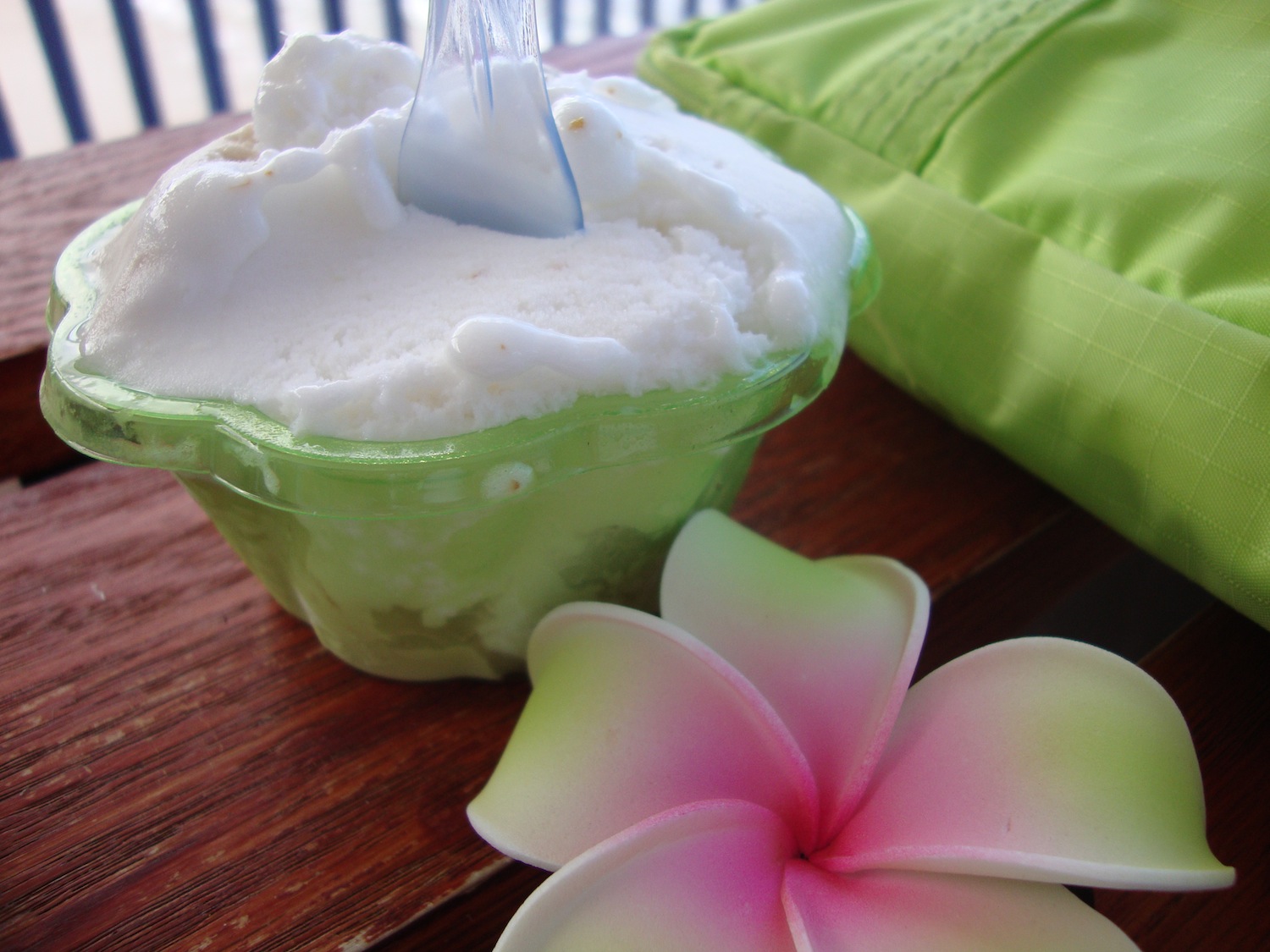
Nothing like lychee gelato to soothe the sun's wrath
A change of scenery raises questions about my long-held notions of identity


Dateline Maui: I am allergic to the sun. Me: the tropical transplant. It could be because I am now more than half my lifetime removed from the tropics. On my arms, neck, back, and legs are mini volcanoes that itch. I am a one-woman walking leper colony. The ship's jawdroppingly hot South African doctor has a fancy name for this unfortunate condition, but it boils (pun intended) down to my being underexposed to sunshine for so long that my skin didn't know what to make of this tsunami of UV rays. So it cooked up these rashes.

To be fair, it isn't Maui's fault. I was on Waikiki beach on Oahu two days ago when all this erupted. I'm pretty sure part of it was mental anguish — it's psychosomatic. You already suspected I am some form of psycho. This confirms it.

I had been anxious about our snorkeling dress rehearsal. My anxiety rose in direct proportion to the hubby's enthusiasm. Between us we had filled four suitcases for a 14-night silver anniversary cruise to Hawaii's four main islands. He packed one more with fins, masks, breathing tubes, beach towels and an underwater camera. What he neglected to provide was a life vest for me. I can't doggy paddle. I'm fine doing the backstroke or breast stroke, as long as there are points A and B to get to and from, if said points allow me to keep my head above water without actually swimming.


"Come out to the deep end," he kept beckoning. "My feet aren't touching the ground," he added, which only caused me to shake my head more. Being reassuring: not his strong point.


Fins and shallow water do not mix. I had gotten the hang of breathing through my mouth, but each time I tried to stand, the fins and even the tiniest of waves knocked me off balance. I felt like a mermaid learning to walk on legs, except a lot less alluring, flailing about, disturbing the sand and gulping down the briny brew. I am a disgrace to my beach-bejeweled childhood. I remember being fearless, standing in neck-deep water hand in hand with friends, waiting for a big wave to crash over us, spinning underwater like agitated laundry until the sea vomited us ashore. Then going back in for more. The first time I realized I had lost that sense of immortality in the water was in my first trimester, a quarter of a century ago. There was another life to consider.


Having failed my non-dry run on Oahu, I reduced us both to staying on land on Maui, where we had hoped to book the actual snorkeling excursion. What does one do on land? The hubby hiked uphill in the stifling humidity; I shopped in air-conditioned comfort. He had bribed me to spend the day apart, so I spent every last penny and then some on a midnight blue dress, an upcycled jeans purse, and Hawaiian shaved ice. I admit it, I am a cheap non-date.


Browsing left plenty of time to brood. While I am no longer the water-loving tropical girl I'd always thought myself to be, neither am I mainland material. But I haven't morphed into anything else. On the big island several days before, at a gift shop, someone had interrupted herself in the middle of a monologue to ask me, "Do you speak English?"

'I'm American," I heard myself assure her, self-consciously adjusting the ivory plumeria I had clipped above one ear. I haven't had to attest to my non-otherness in a very long while. Apparently it doesn't take much for me to re-blend into the tropical scenery. A fake flower, a flowery dress and flip-flops: voila, I pass for Hawaiian.


But here's the most rueful thing about this: Apart from looking the part, which is easy, and keeping the values close to my heart, part of my cultural identity has clearly eroded. After trying to engage with a couple of friendly fellow Filipinos on board the cruise ship, I found I am no longer fluent in Tagalog. You would think 21 years of growing up in the Philippines would've cemented it in my linguistic center. Not so. We spoke only English at home. My parents spoke to each other in the Bicolano dialect. In grade school my mother actually prohibited me from speaking Tagalog with my friends within her hearing. Our household helpers were hired on the basis of their ability to speak English. I didn't even know until my first day of kindergarten that Tagalog existed. Talk about living in a bubble! The bubble enclosed practically everyone in my immediate family, and now their children and grandchildren, as it is an inside joke that most of us struggle to converse with folks we encounter in daily life—the bus driver, the market vendor, etc.

Wherever there is snobbery, there is, inevitably, reverse snobbery. 

I've been teased by college classmates and co-workers about this deficiency. I would never dream of pointing out anyone's poor grammar in English if it's their second language, but this culture that holds politeness in the highest esteem seems to encourage a lapse in manners when it comes to berating someone about broken Tagalog. There's even a quotation that he who doesn't know how to converse in the mother tongue is worse than rotting fish. I suspect it's the other-end-of-the-pendulum response to the rampant colonial mentality that still pervades the Filipino culture. The thing is, given the circumstances of my upbringing, could Tagalog really be considered my mother tongue? I don't consider it so.


So on my checklist of characteristics that have surfaced during this vacation: Allergic to the sun, averse to the sea, and alienated from my own compatriots, to a degree. 

This calls for a sugar rush. I drown my sorrows in lychee-flavored gelato.