Thursday, December 16, 2010

Are you too adaptable to be authentic?


Ah, chameleons, the mood rings of the animal kingdom. Droll faces, fantastic emoting from the skin. We’ve given chameleons a bad rep. We watch their colors shift and dub them the icon of insincerity.
Maybe they’re just adaptable. And that can be a good thing, the thing that ensures survival. But in the human jungle, can too much adaptability cost us our authenticity?
Have you ever worked where the company culture was so toxic and so counter to your nature that just going to work everyday was exhausting? Because having to suppress your views, silence your voice and produce work exactly as specified, with no wiggle room, left you a squeezed out rag on the couch every evening?
And despite this, didn’t you resolve to work within the limitations and swallow the indignities, to nod, smile and be courteous, remember co-workers’ birthdays, stay out of the cat fights, contribute at meetings, and be a good little soldier because by golly, it was decent pay and an enviable job in a county with an 18 percent unemployment rate? Even if it was in a city rated the dumbest in the country.
But didn’t you cling to the hope that this would all lead somewhere good, that your patience, professionalism and stiff upper lip would earn respect, even if grudging, that Rasputin, the boss’s advisor, would ease her chokehold of tyranny and allow you a smidgeon of credit for a job well done, or the busybody would find someone else to water torture with her hallway pettiness?
You haven’t worked at such a place? I hate you. Hush. Let me tell my story. Re-read the three previous paragraphs, and then:
One day the Top Banana sent me a link to What life asks of usa New York Times article. I wrote speeches for him, and this is how he sometimes generated nuggets to sparkle up his remarks. A big event was coming up, and we needed to start panning for gold.
I read the article. It touted the nobility of dedicating your life to the institution, which the author opined “gives meaning to life.” (sound of retching, mine)
Now you have to understand something. The Top Banana and I shared a cultural background, one in which the good of the group always comes before the good of the individual. I grew up on a military base and within a devout Catholic family. I had wanted to be a missionary when I grew up. I understood the sentiment of selflessness on the familial, societal, and spiritual levels.
But I wasn’t sure this was going to go over well. His audience would be several hundred young adults about to be let loose on corporate America. Most had grown up in the United States, fed from birth on a diet of Change the World, not Conform to the Firm. I asked the boss if he had intended for me to spin some of this into his speech.
You could, he said. Did I mention indirectness is another trait common to our culture?
In hindsight, I realize he wasn’t addressing the graduates with this article. He had sent it to me, period.
The Top Banana emailed me the day after I cleared out my office of its feng shui-correct décor. Thank you for your contributions, he said. My wife and I wish you and your family well and miss you already. Big hugs.
Do they make chameleon skin in my size? Will it slowly suffocate me?
This more recent New York Times article talks about bacteria that by nature feed on phosphorus but by willpower (the scientists’, not theirs) subsist on arsenic. As in, poison. Toxic stuff.
“The bacterium, scraped from the bottom of Mono Lake in California and grown for months in a lab mixture containing arsenic, gradually swapped out atoms of phosphorus in its little body for atoms of arsenic.”
‘It’s a really nice story about adaptability of our life form,’ one of the scientists glowed.
While the scientists were patting themselves on the back about their really nice story, I’m thinking, hey, that was me. I had arsenic for lunch every day because the institution said so. You know you’ve sunk low when you empathize with microbes. And not just any pond scum, but bottom-of-the-lake bacterium. But wait, what’s this:
“The cells grown in the arsenic came out about 60 percent larger than cells grown with phosphorus, but with LARGE, EMPTY, INTERNAL SPACES.” (caps mine)
Traces of phosphorus remained in the bacterium despite the force-feeding with arsenic. One scientist described it as “clinging to every last phosphate molecule, and really living on the edge.”
“I was feeling sorry for the bugs,” one of them said.
Important People with compassion! Good to know they’re out there, as the ones I worked with seemed abundant in large, empty, internal spaces. And I don’t just mean between the ears.

You can live your life for the institution all you want. As for me, I will tend to filling my internal spaces, which have become less large and less empty with more time and distance.
Postscript: Within 10 months after the institution and I parted ways, the Top Banana resigned. How are we feeling about the institution now, hmm?

Thursday, November 25, 2010

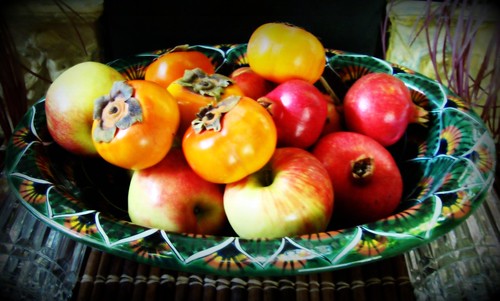
Abundance


Abundance, originally uploaded by scrollwork.
Nothing like paring down to bare essentials to rediscover what exactly those essentials are. In January of 2010, I scribbled some thoughts.

"There's a line from a Leonardo DiCaprio movie:

'Know what you have, what you want, what you can do without: inventory control.' 
— Frank Wheeler, Revolutionary Road

I had to pause the movie to stew in the parallel to my life right now.
The story is set in the 1950s and portrays suburban angst and lives of quiet despair within cozy white bungalows. The angst would ring hollow if set in contemporary times, when holding on to a job and a home would mean you’ve escaped the famine…for now.

Hollywood, and the fans that support this massive system, make “living your dream” a religion.

I don’t dare claim the privilege of having a dream. Right now it’s a daily victory if I manage to quash the fear of my husband also becoming unemployed.

Being unemployed has me envying the postal worker who complained she has to work on Saturdays. It has me being even nicer and more appreciative toward service workers, retail clerks and food servers. Everyone with a job is doing the honorable thing.

When I did have a job, I spent money as one who makes burnt sacrifices at the altar of the implacable god of the economy. I was pumping out stimulus money in a microeconomics way, picking up the tab when friends and I would lunch. What serendipity that I spent the first half of 2009 doing what would turn out to be a dry run for being unemployed: I lived on half my net income, resolutely paying off my credit card debt with the other half. It’s how I learned what I can do without.

Turns out, plenty. I can do without twice-monthly massages and monthly chiro adjustments, haircuts, meals out that hardly satisfy, movies at the cinemax, several bags full of clothes and knickknacks on a whim every weekend, and any acquisition from a junk mail catalog."

Eleven months later, I find that my outlook is different. It's not about what we're doing without (and don't even miss), it's what we had all along that barely merited a glance.

Happy Thanksgiving. Tomorrow when I celebrate another birthday, it will be with full awareness of the abundance with which we have been blessed.

Friday, November 19, 2010

Between me and the deep blue sea


I am afraid of my sewing machine. There, I’ve said it. It wouldn’t matter much, except my fear is what stopped me dead on the tracks as I zipped along toward my reinvention. In my dream new identity, I am a derelict clothing designer, upending mediocrity in women’s apparel and thumbing my nose at cubicle convention. I offer slices of delicious escape to women weary of conforming. I aim to dress fellow misfits who want to make peace with their weirdness.
It’s farfetched when you consider that I have zero background in fashion design and business management. In the last decade I had settled into making a living writing about abstract concepts—leadership, mentorship, gender equity, the value of higher education. Every job I’ve had was a step off a cliff. I had no practice as a reporter, speechwriter, desktop publisher or instructor before becoming one. Whatever skills I didn’t already bring to the table I learned on the job. Fear never derailed me.
Most people fear spiders. I squish them without squirming. Many quake at the thought of public speaking. Pffft. My first job out of college was teaching public speaking to sophomores at my alma mater. My last day job was coaching a CEO on delivering the speeches I wrote for him.
Some people freeze on the edge of the dance floor. As an instructor in ballroom and Latin dance, I demonstrate the promenade, the Cuban chase, the infinity spin and such in front of crowds of strangers and perform several times a year.
But the domestic arts have always been my Kryptonite. That sewing machine haunts me. For years, I kept it boxed in a dark closet in a room I never enter unless I have to store more stuff. It’s not even mine; I bought it for Mom when she visited more often. Now she pleads old age. She says she’s too frail to get on a jetliner and cross the Pacific Ocean.
Summers when I was a tomboy, Mom tried to get me to sit still and learn how to sew. She was an effortless seamstress. I wore a lot of her creations. I should’ve been more appreciative. I should’ve paid attention. I should’ve made my own Home Ec projects instead of letting Mom earn the grade.
Somehow I managed to live nearly five decades without ever feeling the need to know how to sew. Call it a midlife crisis, but a year ago I burned out rehashing the same tired concepts on the job and set off to release my inner Ungaro, upcycled version.


I lurked on etsy.com forums, absorbing, keeping notes, hearting examples. I studied business start-up advice, amassed a roomful of vintage and thrifted material, took out a seller’s permit and designed a digital banner. I handsewed stitch by painstaking stitch, turning out flowy dance pants, frilly tunics, quirky skirts.
I fed my ferocious need to remake something in the image of my vision. It must be a control issue. There are few enough things over which we have control, so let’s let loose with what we wear when we’re doing something for ourselves. Let’s dress for life—not for approval.
I may have the beginnings of my business manifesto! It’s coming together and falling into place. Except for the pesky part about not knowing how to sew by machine.
Here’s the thing: most of those times when I learned how to do something new, I was doing it for the boss.  Learning how to sew will be for me—for the new me I am trying to fashion out of disheartened and disgraced remnants. Do you know what it feels like to attempt this reinvention?
My nephew, Vince, that eagle-eyed spotter of oddities that make great fodder for wry comments, noted Google map’s directions for getting to China from Taiwan. Head west, take this ramp, take this exit, turn left, turn right. They seem regular enough, until you come to:
Step#24: Swim across the Pacific Ocean.
Right. There. It feels like I am about to swim across the Pacific Ocean, and I don’t know how to doggy paddle.